Power outages across the UK grid are increasingly driven by severe weather and aging infrastructure. As more households transition to renewable energy, one of the most common assumptions is that having solar panels or a home battery automatically keeps the lights on during a blackout.
In reality, standard grid-tied solar and battery inverters are engineered to shut down instantly during a grid power failure. This automatic shutdown (known as anti-islanding protection) is a safety requirement designed to prevent your system from feeding high-voltage electricity back into power lines while utility engineers carry out repairs.
To draw power from your solar panels or battery during a blackout, your system requires an Emergency Power Supply (EPS) configuration.
How EPS Works: Isolated Microgrids
An EPS system acts as an automated or manual bridge. When mains electricity drops out, the EPS disconnects your home’s domestic circuits from the primary grid network.
Once safely isolated, the hybrid inverter switches into off-grid mode, creating a self-contained local power grid (a microgrid) inside your home. Energy is routed directly from your battery storage—and, depending on the system, active daytime solar generation—to keep your household powered until the grid returns.
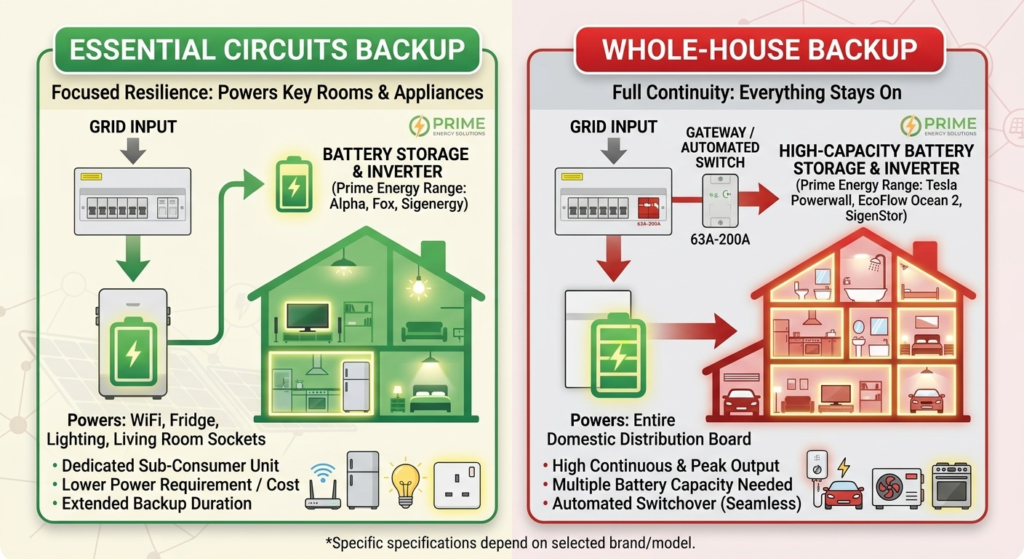
When selecting an EPS design, the primary decision comes down to Essential Circuits Backup versus Whole-House Backup.
Essential Circuits vs. Whole-House Backup
1. Essential (Critical) Circuits Backup
With essential circuits backup, dedicated critical circuits are isolated into a separate consumer unit connected to the inverter’s EPS output.
- What It Powers: Lights, WiFi router, fridge/freezer, alarm systems, television, and standard 13A socket rings.
- What Is Excluded: Heavy inductive or resistive heating loads such as electric showers, induction hobs, heat pumps, hot tubs, and EV chargers.
- Pros: Requires lower inverter power output and modest battery capacity. Highly cost-effective and preserves battery charge over longer grid outages.
2. Whole-House Backup
Whole-house backup routes your home’s main consumer unit through an intelligent backup switch or gateway hub. When a outage occurs, the system isolates the mains supply and powers the entire house.
- What It Powers: Every light switch, socket, and appliance across the property, subject to total peak discharge limits.
- Pros: Uncompromised convenience—no changing habit patterns or restricting which light switches you use.
- Cons: Demands high-capacity inverters, substantial battery output rates, and additional hardware (such as isolation contactors or gateway units), increasing upfront costs.
Technical Considerations & System Requirements
Designing a reliable EPS system involves more than just plugging in a battery. Key considerations include:
A. Inverter Power Output & Peak Surge Capacity
An inverter rated at 3.6kW continuous output can handle lighting and everyday appliances, but it will overload if an electric kettle (3kW) and a microwave (1.2kW) run simultaneously during an outage. In addition, motor-driven appliances (like fridge compressors or sump pumps) require short bursts of high “surge” power to start up—often double their running wattage.
B. Battery Continuous Discharge Rate
A large battery capacity (e.g., 15kWh) does not automatically mean high instantaneous power. If a battery’s maximum continuous discharge rate is capped at 3kW, the system cannot output more than 3kW at any single second regardless of how much energy remains in storage.
C. Changeover Time (Switchover Speed)
Different manufacturers achieve grid isolation at varying speeds:
- Seamless / Zero Milliseconds (0ms): Desktop computers, servers, and sensitive smart home equipment stay online without rebooting.
- Standard EPS (<10ms to 30ms): A momentary flicker where sensitive electronics may restart, but lights and general appliances remain unaffected.
- Manual Changeover: Requires turning a manual isolator switch to transfer circuits to backup mode.
D. Earthing & Neutral Bonding Regulations
Under UK wiring regulations (BS 7671), when a home is disconnected from the main grid, it loses its grid earth connection. An EPS installation must include a dedicated earth electrode (earth rod) and an automated earth-neutral bonding relay to ensure residual current devices (RCDs) operate correctly and maintain electrical safety off-grid.
EPS Capabilities Across the Prime Energy Solutions Range
At Prime Energy Solutions Ltd, we supply and install leading energy storage platforms tailored to your backup expectations:
- Tesla (Powerwall 3): Offers built-in whole-home backup capability via the Tesla Backup Gateway. Delivers high continuous power output (up to 11kW single-phase) with automatic grid detection and storm protection features.
- Sigenergy (SigenStor): Features seamless transition backup options with zero-millisecond switchover speeds (0ms) through its smart Backup Switch and Load Hub, supporting intelligent load management between heavy appliances and essential circuits.
- EcoFlow (Ocean 2 Series): Features an integrated whole-home backup switchover capability with high continuous discharge rates and built-in AI load distribution across multi-MPPT arrays.
- Alpha ESS (Smile Series): Built-in EPS capabilities ideal for essential circuit isolation, featuring modular expansion options and robust physical safety protections.
- Fox ESS (All-In-One / EVO Series): Delivers integrated EPS backup functionality with sub-10ms switchover times, keeping key household appliances running smoothly during grid disruptions.
Designing Your Outage Resilience Strategy
Whether you require basic security for home-office connectivity and food refrigeration or complete off-grid independence for your entire property, proper system sizing is essential.
At Prime Energy Solutions Ltd, our MCS-certified engineers evaluate your property’s electrical distribution board, daily consumption metrics, and priority circuits to deliver a safe, fully compliant backup installation.